Why Your Food Tastes Flat — And What To Do About It
There’s a moment almost every cook knows.
You’ve followed the recipe. You’ve added all the seasoning. Maybe even more than it called for. But when you taste it — something is still off. It’s not quite there. Something is missing and you can’t name what it is.
That feeling is not about the recipe failing you. It’s about not yet understanding how flavor actually works.
The real problem isn’t seasoning
Most people think more seasoning equals more flavor. So when food doesn’t taste right, the instinct is to add more. More salt. More seasoning cube. More pepper.
The result is food that’s salty — but still not deep. Still not rich. Still not the kind of food that makes people pause mid-bite.
Strong flavor and balanced flavor are not the same thing. One assaults you. The other satisfies you.
Professional cooks don’t season more. They season smarter. They understand that flavor is built — not added.
Flavor is made of seven elements
Every dish you eat is built from some combination of these:
Salt. Not just for saltiness — salt amplifies everything else in the dish. It lifts sweetness, balances bitterness, and makes food taste more like itself.
Acid. Lemon juice, tomatoes, vinegar. Acid brightens flavor. When food tastes flat even after salt — what it often needs is acid, not more salt.
Sweetness. Balances bitterness and heat. Even savory dishes have background sweetness working quietly — from caramelized onions, cooked tomatoes, or a touch of natural sugar.
Umami. The savory depth that makes you keep eating. Found in crayfish, dry fish, iru, tomato paste, and properly browned meat. This is the “something more” people can’t name.
Aroma. Most of what you call flavor is actually smell. Spices and herbs release aromatic compounds that tell your brain what you’re eating. Old, stale spices produce flat food — not because they’re wrong, but because they have nothing left to give.
Bitterness. Controlled bitterness adds complexity. Accidental bitterness — from burnt spices or overcooked vegetables — ruins dishes.
Mouthfeel. Thin soups feel weak even when well seasoned. A full-bodied, properly reduced sauce feels more satisfying on the tongue. Weight matters.
When any one of these elements is missing or underdeveloped — the whole dish suffers.
The mistake most home cooks make
Relying entirely on seasoning cubes to provide all the depth in a dish.
A cube gives salt and some umami. That’s it. It doesn’t give aroma, acid, proper sweetness, or mouthfeel. A dish built entirely on cubes will always taste one-dimensional — because it is.
The other mistake is timing. Seasoning at the end of cooking means the seasoning sits on the surface of the food. It doesn’t penetrate. The first bite might taste right — but the inside of the protein or the center of the rice isn’t carrying any of that flavor.
Professional cooks season throughout the process. Each stage needs something different from the next.
Flavor is built in layers
This is the principle that changes everything.
Great food is never achieved in one step. It’s built — ingredient by ingredient, moment by moment. Aromatics first. Then fat. Then protein. Then liquid. Each stage builds on the last.
The reason restaurant food tastes deeper isn’t better ingredients. It’s patience. Onions given time to soften and sweeten. Tomato bases reduced until the raw smell is completely gone. Meat seared until properly brown — not grey. Stock used instead of water.
Each of those steps is a layer. Skip any one of them and the final dish will feel like it’s missing something — because it is.
One exercise to start with
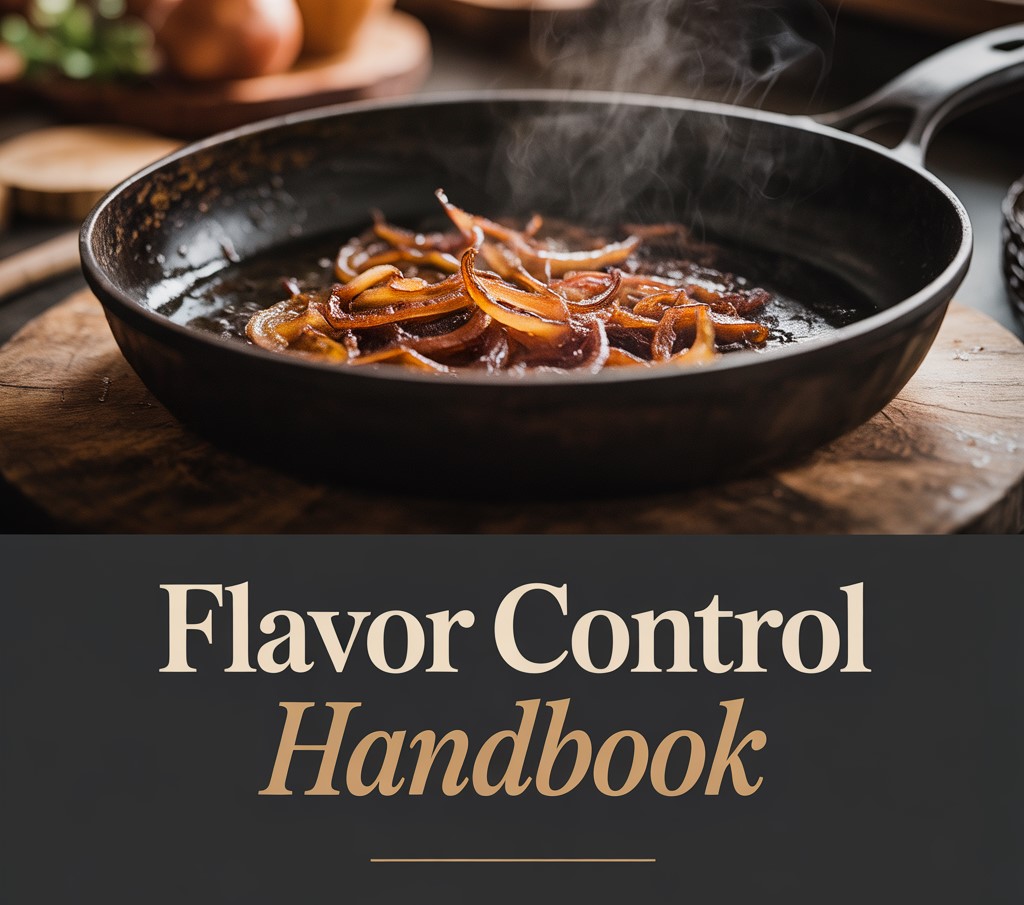
Cook sliced onions in a pan with a little oil and nothing else. No salt, no seasoning. Low heat for 20 minutes.
Then taste.
You’ll notice sweetness you didn’t know was there. That natural sweetness is a flavor layer most home cooks rush past. Add a pinch of salt and taste again — notice how it amplifies what was already present.
That awareness is the beginning of real flavor control.
The full breakdown
Everything above is just the surface.
The Flavor Control Handbook goes through all of it in detail — the seven flavor elements, how to layer properly, heat control, seasoning proteins and rice and sauces, Nigerian flavor systems, how to fix common problems, and the restaurant principles you can apply at home today.
It’s the most complete thing I’ve put out.
[GET THE FLAVOR CONTROL HANDBOOK — ₦12,500]